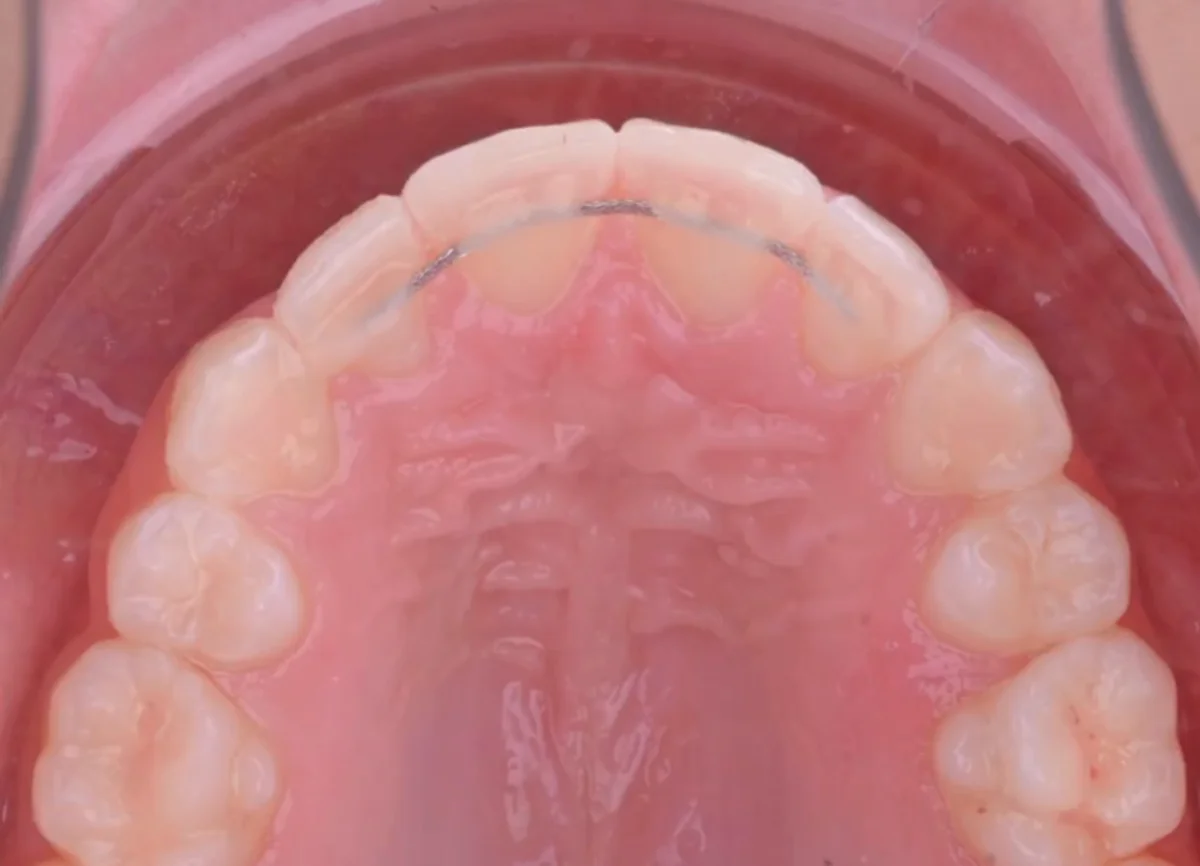
A lingual retainer is a thin wire bonded to the inner surface of your teeth after orthodontic treatment to prevent them from shifting back. If not cleaned properly, tartar can build up around the wire over time.
Why Is Flossing More Challenging?
Because the retainer is fixed to the back of your teeth, the wire blocks the normal passage of floss between teeth. A slightly different technique is required.
Step-by-Step Flossing Technique
- Use a floss threader — This small plastic tool lets you guide the floss under the wire so you can clean between each tooth.
- Clean each gap individually — Slide the floss up to the gumline and move it gently up and down.
- Try a water flosser (oral irrigator) — A water flosser is highly effective at removing food debris around the retainer wire.
- Use interdental brushes — Small interdental brushes can reach spaces beneath the wire that regular floss may miss.
How Often Should You Clean It?
I recommend flossing every day, ideally after your evening brushing. Skipping days allows tartar to accumulate around the retainer, which may require a professional cleaning to remove.
If you have any questions or concerns about your retainer, don’t hesitate to contact your orthodontist.
Related page: Lingual (Inside) Braces
References
- Zachrisson BU. Long-term stability: bonded lingual retainers. Semin Orthod. 2007;13(4):245-259.
- Renkema AM, et al. Long-term effectiveness of orthodontic treatment with bonded lingual retainers: a post-retention evaluation. Eur J Orthod. 2013;35(5):546-552.
- Littlewood SJ, et al. Retention procedures for stabilising tooth position after treatment with orthodontic braces. Cochrane Database Syst Rev. 2016;1:CD002283.