When active orthodontic treatment ends, tooth movement stops — but teeth do not automatically stay put. The surrounding periodontal tissues, soft tissue pressures, and (in younger patients) ongoing jaw growth continue to act on teeth over time. A retainer manages this phase.
Why Are Retainers Needed?
Throughout orthodontic treatment, the bone and connective tissue around teeth remodel. When appliances are removed, this remodelling is not yet complete. Without something to hold the position, forces acting on teeth may cause relapse — a partial or full return of the original irregularity.
Relapse risk is not the same for everyone. The type of original malocclusion, jaw growth pattern, and individual biology all play a role, which is why retention plans are personalised.
Types of Retainers
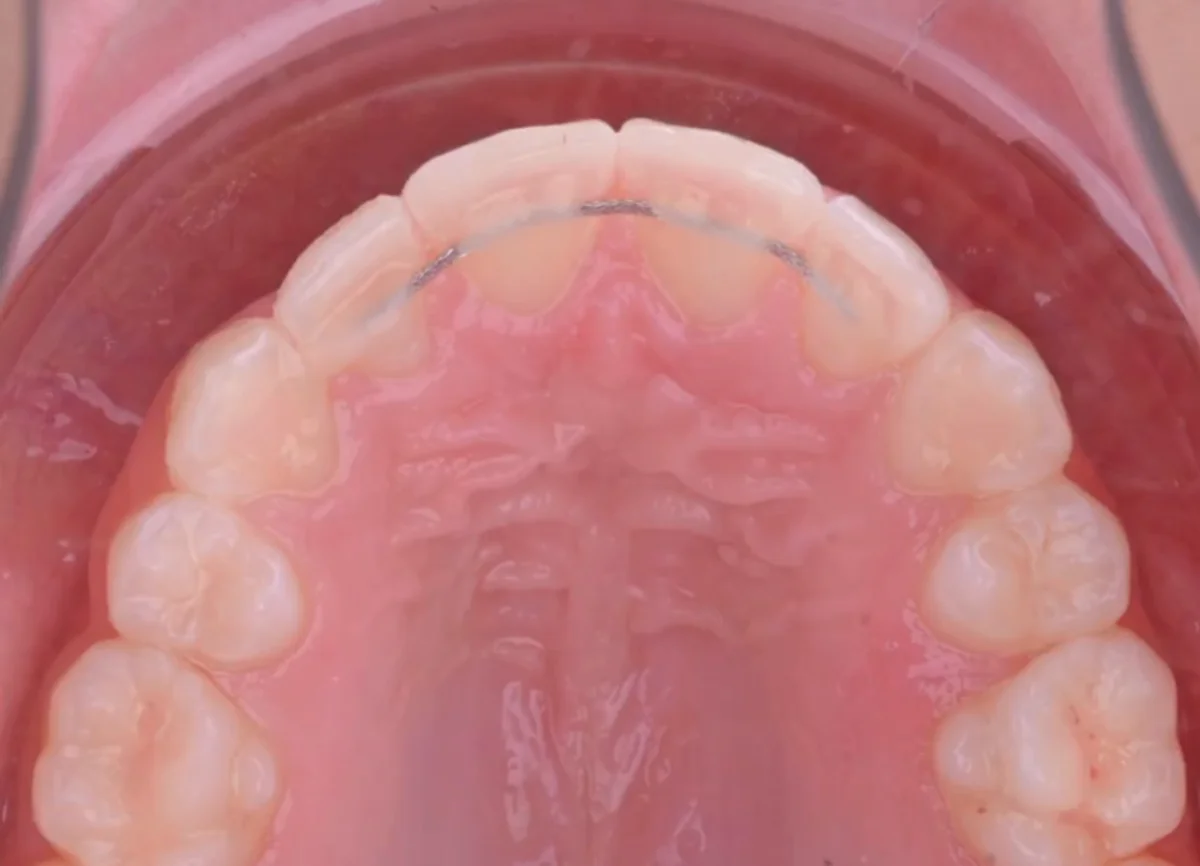
Fixed (Bonded) Retainer
A thin wire is bonded to the inside (tongue-facing) surfaces of the teeth. It cannot be removed by the patient and stays in place continuously.
- Requires no patient compliance decisions
- Targets the anterior teeth; not typically extended to posterior segments
- Needs daily cleaning; plaque and calculus can accumulate around the wire
- A broken bond or bent wire requires a clinical check
Removable Retainer
Two main designs: the traditional wire-and-acrylic Hawley retainer, and the vacuum-formed (Essix) clear retainer.
- Must be worn for prescribed hours; compliance matters
- Easy to clean separately
- Hawley retainers tend to be more durable; clear retainers can discolour or wear down
- Risk of loss or damage
In many cases, a fixed and a removable retainer are used together.
How Long Should You Wear a Retainer?
There is no universally agreed endpoint. Current evidence supports long-term, possibly indefinite retention. A typical approach:
- First year: Removable retainer worn most of the day, including at night.
- Subsequent period: Night-only wear may be introduced, but this varies by case.
- Fixed retainer: May remain in place long-term; monitored at check-ups.
There is no guaranteed age or time point after which a retainer can safely be abandoned. Even stable-looking teeth can shift gradually with physiological ageing.
Care and Maintenance
- Clean around a fixed retainer daily with floss or an interdental brush.
- Rinse removable retainers with cool water — hot water can warp the plastic.
- Do not try to adjust a retainer yourself; deformation or breakage is possible.
- Have retainer condition assessed at regular dental or orthodontic check-ups.
What Happens Without a Retainer?
The previously corrected irregularity may partially or fully return. The rate differs between patients — gradual over years in some, faster in others. Whether retreatment is needed after relapse depends on clinical assessment.
However well your treatment went, wearing your retainer is how you protect that result.
Related pages: Clear aligner orthodontics · Braces (Fixed Appliances) · Flossing with a lingual retainer
References
- Littlewood SJ, et al. Retention procedures for stabilising tooth position after treatment with orthodontic braces. Cochrane Database Syst Rev. 2016;1:CD002283.
- Proffit WR, Fields HW, Larson B, Sarver DM. Contemporary Orthodontics. 6th ed. Elsevier; 2019. (Retention and stability.)
- Lie Sam Foek DJ, et al. Bonded versus vacuum-formed retainers: a randomized controlled trial. Part 1: Stability of anterior occlusion at 1 year. Eur J Orthod. 2009;31(6):669-679.
- Al-Moghrabi D, et al. Compliance with removable orthodontic retainers and patient experience: a systematic review and meta-analysis. Am J Orthod Dentofacial Orthop. 2017;152(1):17-29.